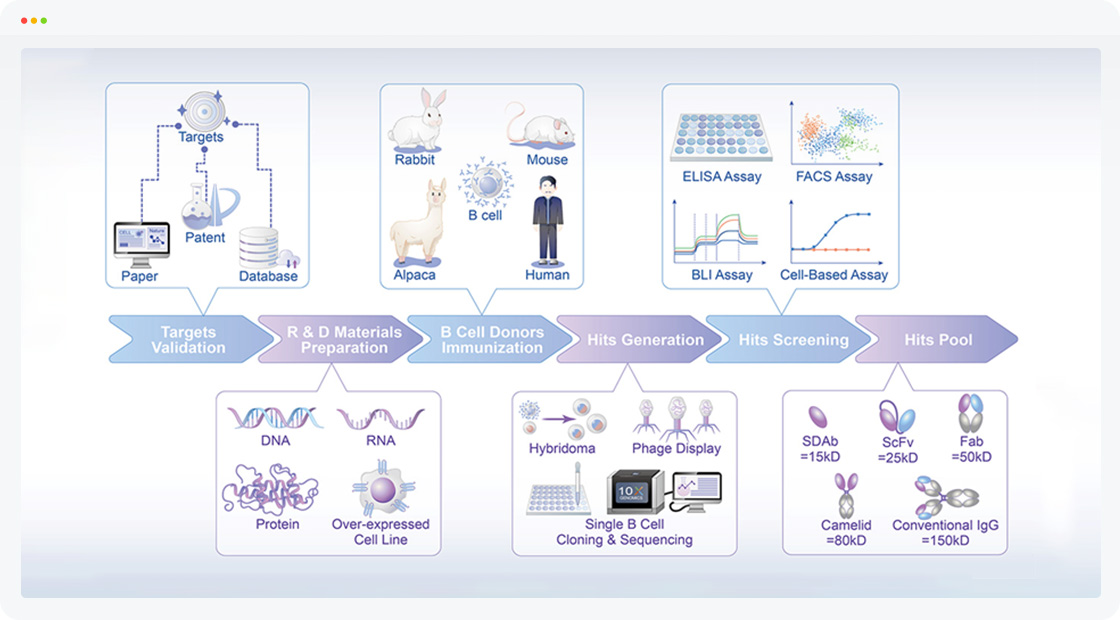
Antibody discovery technologies: hybridoma technology, phage display technology, single B cell technology and humanized mouse technology
1) Hybridoma technology
Principle: B lymphocytes from immunized animals are fused with myeloma cells to generate hybridomas that both express specific antibodies and proliferate indefinitely in vitro. Fast-growing clones with high expression levels are isolated by high-throughput screening and expanded to produce monoclonal antibodies at scale.
Symray offers a diverse range of immunization formats (nucleic acids, proteins and cells) together with efficient hybridoma generation and screening strategies, providing a complete solution from gene sequence to hybridoma development and characterization.
2) Phage display technology
Principle: exogenous genes are recombined into the genome of a phage capsid protein and displayed on the phage surface as fusion proteins, thereby constructing a library. Through solid-phase panning, phages binding the target of interest are selected, amplified by host infection and carried into the next round of panning; after 3–5 rounds, a highly enriched phage population that specifically displays the target protein is obtained. Monoclonal clones can then be isolated by ELISA or FACS.
Symray’s antibody library capacity reaches the hundred-billion level (10^11 pfu). A two-step library construction method ensures library diversity, enabling the generation of antibody libraries from multiple species (human, mouse, rabbit, alpaca, chicken, dog, monkey, etc.) and in multiple formats (scFv, Fab, VHH, etc.).
3) Single B cell technology
Principle: a light-guided (optofluidic) system is used to screen and locate, at high throughput, B cells that express specific antibodies; sequencing then yields their expressed sequences, enabling rapid recovery of monoclonal antibodies.
Combined with multiple PCR technologies and an automated high-throughput flow cytometry screening system, Symray supports the development of antibodies with high throughput, high efficiency, high stability and high specificity.

 All Species
 All Epitopes
 All Functions